
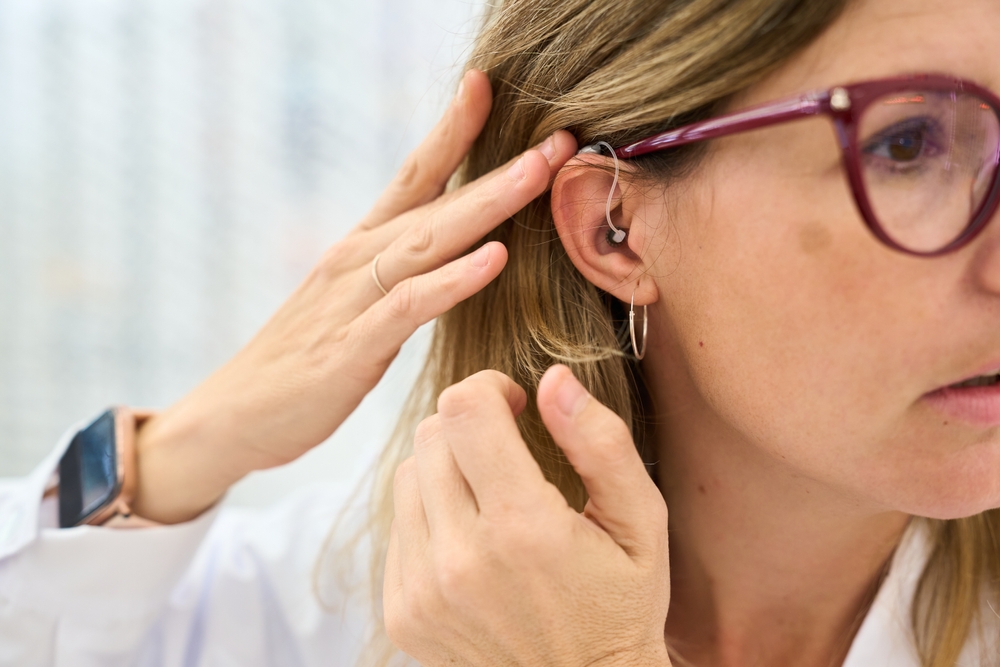
It is incredibly common for individuals to resist getting hearing instruments simply because they dread a bulky appearance or an uncomfortable fit. That defensive reaction is totally logical from a consumer standpoint! Regrettably, some people even experienced social alienation because acquaintances falsely assumed that wearing a visible aid signaled a complete inability to comprehend spoken dialogue.
This obsolete perception remains deeply embedded in the public consciousness, creating a massive barrier to proactive treatment. However, contemporary medical engineering has ensured that current hearing solutions look and function in a completely unexpected manner. Ongoing innovations in cosmetic engineering mean today’s options are ultra-small, seamlessly comfortable, and beautifully hidden from public view.
If you have spent years avoiding an audiologist due to the appearance of old devices, now is the perfect moment to explore today’s sleek alternatives!
Why the Bulky, Obvious Hearing Aid Is a Thing of the Past
If you close your eyes to conceptualize a hearing system, your mind likely crafts a picture of a prominent, cumbersome unit draped behind the ear. If that description matches your mental model, your perceptions are anchored in the primitive analog technology of the late twentieth century.
In the intervening decades, the entire field of otolaryngology and acoustic engineering has undergone a massive paradigm shift. Continuous refinements in ergonomic styling, nanometer-scale circuitry, and digital audio engineering have radically overhauled the modern cosmetic profile. They’re smaller, sleeker, and designed to blend in (or disappear entirely).
Numerous modern instruments are inserted completely within the ear canal structure, rendering them undetectable throughout standard daily dialogue. Alternatively, post-auricular models are constructed with such streamlined dimensions that they disappear against the scalp, customizable to complement individual skin and hair coloration.
Primary Hearing Aid Styles, From Invisible to Barely There
For those investigating what these advanced acoustic tools look like in real life, consider this straightforward guide:
Invisible-in-Canal (IIC) Technology
These are as discreet as it gets. An IIC device is positioned entirely past the second bend of the auditory canal, fabricated from a personalized physical matrix of your unique anatomy. When engaging with others at standard social distances, these units are utterly unnoticeable to the naked eye. They remain an exceptionally sought-after solution for patients with mild-to-moderate deficits who refuse to compromise on cosmetic privacy.
Modern Standards: Receiver-in-Canal (RIC) / Receiver-in-the-Ear (RITE)
This particular layout has become the benchmark standard for contemporary hearing health restoration. The system utilizes an incredibly small housing resting behind the ear, linked by a hair-thin translucent cable to a miniature speaker within the ear pathway. To a casual observer, their clean lines often mimic high-end commercial wireless earbuds. Unless an individual is specifically searching for the device, it remains completely unnoticed during normal interactions.
Behind-the-ear (BTE)
These units reside entirely behind the external ear, providing a slightly larger chassis that is still infinitely more elegant than historical variations. They’re often recommended for more significant hearing loss and offer excellent performance without the bulky appearance people expect.
The fundamental lesson is clear: current acoustic technology is engineered to integrate seamlessly into your personal lifestyle, never to advertise an impairment.
How Current Hearing Technology Outperforms Traditional Amplifiers
The evolution of these medical devices encompasses much more than a superficial face-lift. Present-day models perform like advanced personal audio computers instead of basic medical listening aids. Many connect directly to your phone via Bluetooth, letting you stream calls, music, or even TV audio straight to your ears with no headphones needed.
Through proprietary mobile apps, patients can effortlessly adjust acoustic thresholds or modify directional settings completely hands-free. If you enter a chaotic, crowded room, you can optimize your digital noise reduction settings to isolate speech within seconds. Rechargeable batteries have also replaced the tiny ones people used to struggle with. Just place them on a charger overnight, like your phone.
Getting Over the Fear and Stigma of Hearing Devices
Despite being aware of these massive design improvements, it is entirely normal to feel a sense of hesitation. Initiating an auditory health journey can feel emotionally taxing because it requires acknowledging that our physical baseline has shifted over time. This mental hurdle can make an individual feel exposed, creating a false impression of losing authority over personal wellness.
However, an alternative, empowering framework exists: utilizing hearing technology is never an indicator of structural failure. They are merely an intelligent adaptation to a universal milestone of aging that impacts us all eventually. Adopting this tech is definitive proof that you are actively taking charge of your health to empower and protect your daily cognitive function.
Visualize the freedom of utilizing a completely covert acoustic system that restores your ability to track jokes, engage in crowded restaurants, and capture every nuance of the activities you love. Talk about empowering!
See For Yourself What Today’s Hearing Aids Look Like
The quickest way to erase your grandfather’s mental model is to physically interact with twenty-first-century hearing tech. We encourage you to drop by our office, address your concerns, and hold these miniature devices yourself with zero sales pressure. View this consultation simply as a tactile opportunity to discover just how radically changed this technology has truly become.
You will likely be utterly delighted to discover how microscopic, physically seamless, and high-performing today’s options truly are! Call our office to schedule your visit online today.