
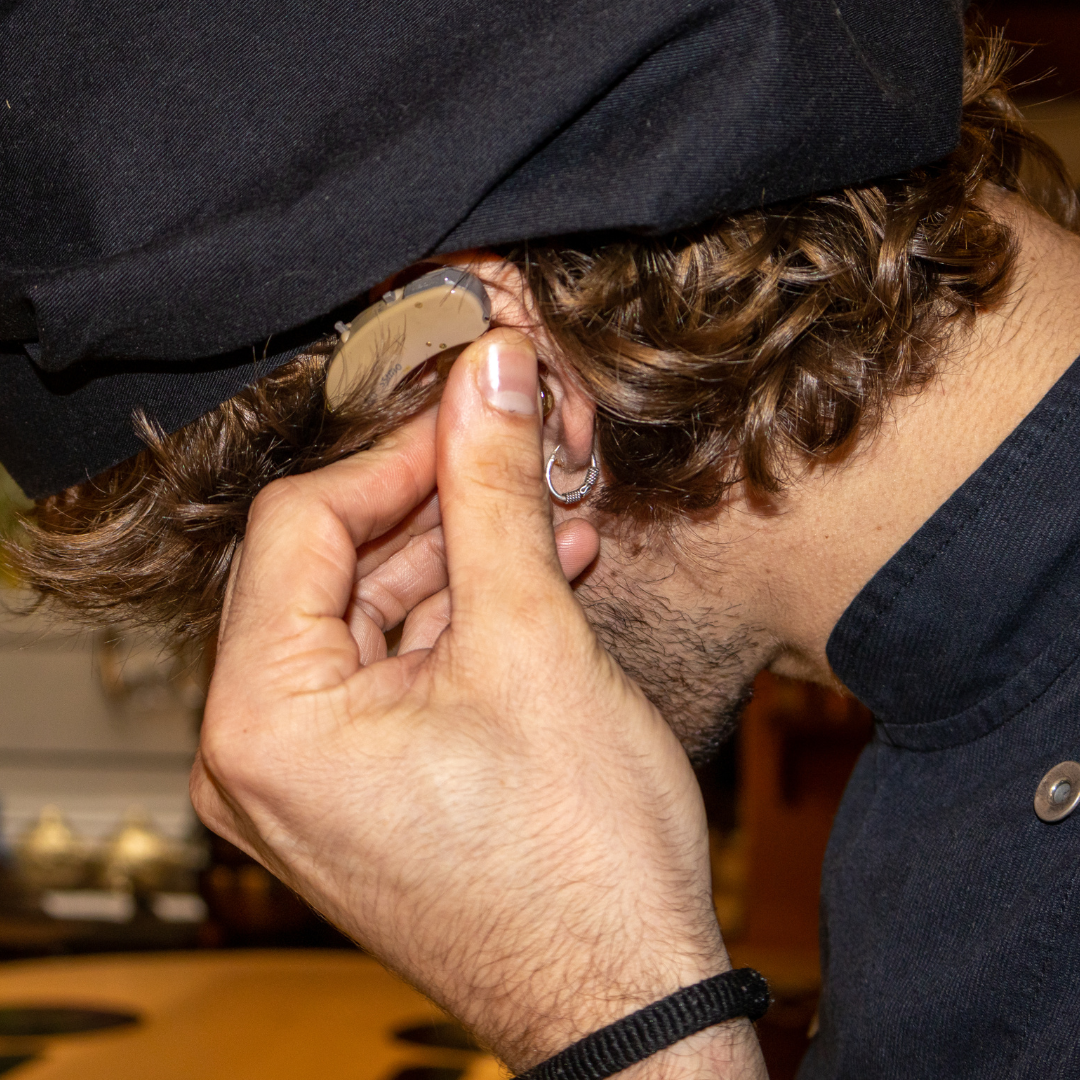
Restaurant conversations can be difficult to follow when environmental noise competes with your focus and hearing. Our practice provides targeted diagnostics to evaluate hearing in quiet atmospheres as well as complex noise environments. After uncovering the precise factors driving your difficult hearing, our team helps you select individualized auditory solutions.
How Can Hearing Seem Normal at Home but Fail in a Restaurant?
A quiet setting creates an optimal signal-to-noise ratio, ensuring the conversational partner’s voice rises cleanly above ambient sounds. Restaurants create the opposite situation. Overlapping chatter, piped music, kitchen clatter, and hard-surface reverberation mask speech, forcing the brain to expend immense cognitive effort to track conversation.
These communication barriers frequently indicate high-frequency hearing loss, central auditory-processing disorders, or age-related sensorineural changes. Cognitive exhaustion, physical fatigue, low ambient lighting, and increased distance from your conversational partner further compound the challenge. Many individuals register normal audiometric thresholds on standard pure-tone screenings yet show profound deficits during speech-in-noise testing. Experiencing speech-recognition struggles in noisy dining venues warrants a formal audiological evaluation regardless of seemingly normal quiet hearing.
Clinical Evaluation of High-Frequency Hearing Loss
We begin by reviewing your history of communication difficulties, prior noise exposures, ringing or tinnitus, pharmaceuticals, and unilateral symptoms.
Pure-tone audiometric evaluations measure the absolute quietest sounds audible across specific octave frequencies using air and bone conduction. Patients with high-frequency hearing loss typically exhibit a sloping audiogram configuration where sensitivity steadily declines at elevated pitches. Diagnostic evaluations may also integrate acoustic tympanometry to check middle-ear pressure alongside word-recognition testing to evaluate speech processing.
A quiet sound booth cannot replicate complex dining room acoustics, which makes clinical speech-in-noise testing especially informative. This procedure gauges speech-discrimination accuracy while competing multi-source noise becomes incrementally louder. Together, these audiological findings indicate whether the issue involves sound audibility, speech intelligibility, noise-processing dysfunction, or multiple compounding factors.
The Role of Central Auditory Processing Disorders in Adults
Auditory processing disorders interfere with the brain’s ability to process and decipher acoustic signals arriving from the ears. Even when the ears detect individual frequencies accurately, the central auditory system may falter at sorting overlapping voices, distinguishing close speech sounds, or processing fast-paced dialogue. We first evaluate peripheral hearing and then determine whether an individualized auditory-processing test battery or referrals to other professionals are appropriate.
Behavioral Strategies for Hearing Clearly in Loud Venues
Strategic behavioral modifications can substantially improve the auditory signal reaching your ears while maximizing supportive visual cues. Prior to dining, choose venues known for lower noise levels or schedule meals during quieter dining hours. Establishments designed with high-walled booths, acoustic wall treatments, heavy fabrics, and carpeting reduce reverberation far better than modern industrial spaces with bare surfaces.
In-venue communication guidelines:
- Reserve a table located well away from kitchen doors, active bar counters, overhead speakers, and banquet groups.
- Sit with your back near a wall to reduce noise coming from behind you.
- Face your conversation partners in good lighting.
- Reduce physical spacing between yourself and companions to maximize direct speech perception.
- Position your better-hearing ear directly toward your main conversational partner.
- Encourage speakers to rephrase key information rather than simply repeating unparsed words louder.
- Validate significant pieces of information directly rather than feigning understanding during dialogue.
- Step away for a brief auditory rest when cognitive listening fatigue begins to set in.
- Invite companions to focus on clear articulation and a measured, comfortable cadence.
- Speaking with excessive volume creates acoustic distortion that fails to make words clearer.
Assistive Hearing Tools and Technology for Complex Acoustic Environments
Determining the proper hearing technology hinges on the underlying disorder, everyday listening environments, and whether peripheral hearing loss is diagnosed. Customized hearing aids employ directional microphone beamforming, noise cancellation algorithms, and targeted dining programs to prioritize speakers in front while lowering ambient noise. Users should establish realistic expectations because no hearing device can fully eradicate all unwanted ambient speech.
Pairing your devices with a remote wireless microphone generates a substantial improvement in the direct signal-to-noise ratio. Clipped near the speaker’s mouth or set nearby, the transmitter sends voice signals wirelessly to matched hearing aids or a receiver. This wireless transmission substantially diminishes the acoustic degradation caused by physical distance and ambient room noise.
Other clinically valuable tools include:
- Multi-directional table microphones designed for small dinner gatherings
- Telecoil sensors configured to access hearing-loop broadcasts in looped facilities
- Mobile speech-to-text applications delivering instant visual captions during dinner
- Smart earbuds offering dedicated speech-in-noise amplification settings
- Decibel-monitoring apps and crowd-sourced dining platforms that track restaurant noise
We will help compare available technology, verify device compatibility, and instruct you on utilizing your selected hearing equipment.
The Clinical Role of Audiologists in Managing Loud Environments
A professional clinical assessment moves beyond basic baseline statements like “I hear fine in quiet rooms.” We assess the specific acoustic settings, speaker dynamics, and volume levels that disrupt your hearing to administer targeted evaluations. Testing routinely combines pure-tone audiometry, middle-ear impedance tests, speech discrimination, and speech-in-noise measures. Central auditory-processing testing is considered whenever clinical intake and initial test outcomes point toward higher-order deficits.
Abrupt auditory reductions, unilateral hearing shifts, or rapid functional deterioration require prompt assessment by an ear, nose, and throat physician. Comprehensive clinical care targets the physiological roots of hearing difficulties rather than simply writing them off as bad restaurant acoustics.
Schedule a Diagnostic Hearing Evaluation Right Away
If restaurant conversations leave you guessing, withdrawing, or feeling exhausted, schedule a comprehensive hearing evaluation with us. We provide proven treatments to enhance your hearing in noisy environments, offering hearing aid fine-tuning, specialized assistive accessories, and individualized auditory therapy.
Contact our audiology office today to schedule your evaluation and move toward effortless, confident conversations.